In mathematics, a formula generally refers to an equation or inequality relating one mathematical expression to another, with the most important ones being mathematical theorems.
In math, a formula is an expression that through operations such as addition, subtraction, multiplication and division different quantities or variables are related.
A formula in mathematics is a fact or rule expressed using mathematical symbols, typically connecting two or more quantities with an equal sign. Formulas serve as fundamental tools that allow us to find unknown values when we know certain related values.
A formula is a fact or a rule written in mathematical symbols. It contains a set of instructions on how to calculate an unknown quantity in terms of one or more known ones.
Formulas are widely used in mathematics. A basic formula for the area of a rectangle has already been discussed above. Now we will discuss some other widely used formulas here. The formula for the square of the sum or difference of two numbers is a very basic algebraic formula and is widely applied.
Formula is a fact or a rule written with mathematical symbols connecting two or more quantities with an equal sign. Learn some basic formulas in math and examples.
In mathematics, a formula is an equation that shows the relationship between different variables or quantities. Formulas are essential because they provide a shorthand way to describe complex relationships and make calculations easier.
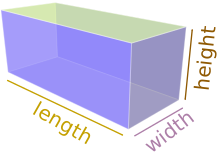
What is a Formula? A formula is a fact or rule that uses mathematical symbols. It shows us how things are related to each other. Example: The formula for finding the volume of a box is: V stands for volume, l for length, w for width, and h for height. When l=10, w=4, and h=5, then: V = 10 × 4 × 5 = 200.
 Illustrated definition of Formula: A rule or fact written with mathematical symbols. It usually has: an equals sign (=) two or more...